
This is the real step-by-step process I went through in 2022 when my younger sister moved to Japan.
There isn’t one “correct” order to complete all the procedures, but from my experience, doing them in this sequence will save you time and energy.
💡 Before leaving Malaysia, make sure you’ve filled out the VJW (Visit Japan Web) form — you’ll need it after passing immigration.
Step 1: Receive Your Residence Card at Immigration
When you enter Japan, the airport will issue your Residence Card (front side shows your personal info, back side is blank for your address).
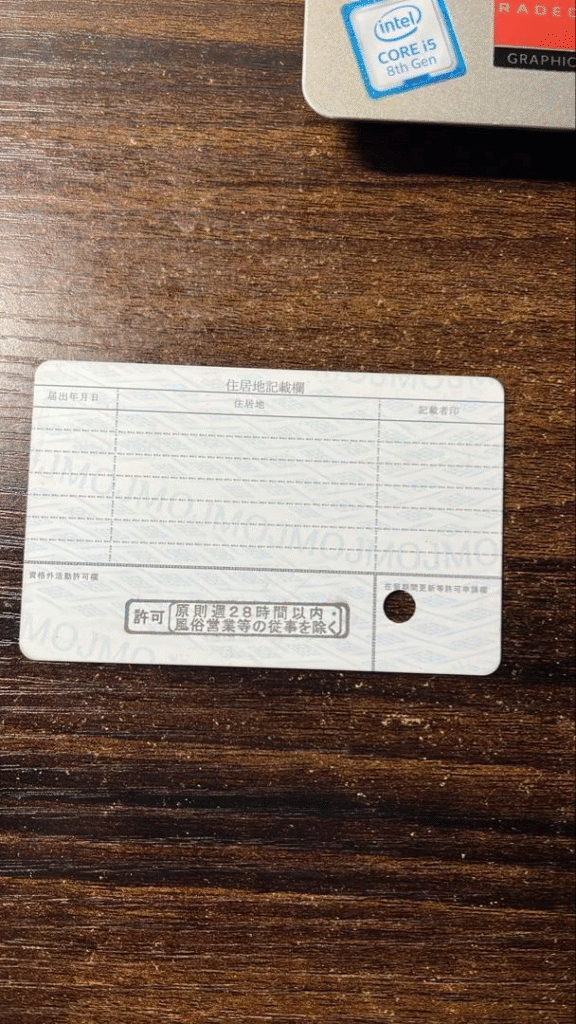
⚠️ Important for those who want to work part-time:
- If you plan to do any part-time job in Japan, fill in the “Permission to Engage in Activity Other Than That Permitted” application while still in Malaysia, and submit it together with your documents at immigration.
- I wasn’t told this by my agent, so later I had to spend 4 hours at the Immigration Bureau just to get my work permit. Don’t make the same mistake!
- To check if you’re approved, look at the bottom of your Residence Card — there should be a special stamp (see photo example ↓).
Step 2: Make Your Personal Seal (Hanko)
In Malaysia, we rarely use personal seals, but in Japan, a hanko (stamp) is needed for many procedures.
You can make one easily at Don Quijote’s self-service machines for around 500–1000 yen. Choose a small round stamp (smaller than a 1 sen coin).
Usually, just your surname is enough, for example:
- Passport name: TAN XXX XXX
- Hanko: TAN タン
The red ink pad and storage case can be found at any 100-yen shop.
🔑 Name tips:
- Write your name based on the pronunciation in your passport.
- Example: Passport name TAN MING LIANG (陳明亮) → should be written as タン ミン リアン.
- Don’t use the Chinese reading (チン メイ リョウ) because Japan may ask for official proof of your Chinese name, which we don’t have in Malaysia.
- If your language school gives you a katakana name that doesn’t sound right, ask them to fix it immediately! My teacher once wrote my name as QINGクイン (sounds like “Queen”), which was funny but definitely not me 😂.
Step 3: Register Your Address at the Ward/City Office (within 14 days of arrival)
Pick a nice weather day and set aside the whole day for this, since you’ll need to visit multiple counters. Eat a good meal beforehand!
You’ll need to fill out the “住民異動届 (Jumin Idou Todoke)” form:
- First-time entry → write your arrival date in Japan.
- Moving house → write your new move-in date.
If you’re unsure, just explain everything to the staff. Usually, someone will guide you through the whole process.
My first time was a struggle — I used Google Translate + a little English from staff + hand gestures to survive. I even went to the wrong ward office and wasted 5000 yen on a taxi 😭.
👉 Pro tip:
- You’ll need the postal code (郵便番号) when filling in your address. Format is usually
123-4567. - Example: For “Shinjuku Sanchome”, search “新宿区新宿三丁目 郵便番号” and you’ll find 160-0022.
- This number is very useful — in many online forms, typing the postal code will auto-complete your address.
Step 4: Apply for National Health Insurance + My Number Card
(Do this on the same day as your address registration.)
– National Health Insurance
- Covers 70% of medical costs (dentist visits, fillings, surgery, etc.).
- Schools will also ask for proof of this insurance when you register.
– My Number Card
- This will replace your health insurance card in the future.
- It’s needed for updates to your Residence Card, pension, and other admin tasks.
- There’s also a useful app called Mynaportal.
📌 Reminder: The validity of your My Number Card follows the expiry date of your Residence Card. Always renew both together to avoid extra fees or delays.
Step 5: Register Your Address at the Post Office
At the beginning, important letters from banks, city office, or insurance will be mailed to your home. If your address isn’t in the system, deliveries may get delayed.
By registering your address at the post office, you ensure all mail arrives properly.
When you move to a new house, simply update your new address at the post office — old mail will be forwarded automatically.
✅ Once you’ve finished these steps, your basic life setup in Japan is complete!
The most important things are:
- Part-time work permit,
- Personal seal (hanko),
- National Health Insurance.
These will save you from a lot of headaches later on.